W
Saturday, April 07, 2018
Sorry Not in Service
I don't really have time to continue here, at least for now, so we are going on Hiatus until further notice.

Sunday, March 25, 2018
The bicycle as a camera platfrom
Can we marry up the
two, where a bicycle can be used as a camera platform? The short
answer is yes, the long answer, well that’s what we are discussing
for the final entry for March…..
One of the things we
need to be careful of is that cameras are a little fragile, having an
expensive camera strapped to you, during an off bike experience, is
not good for the camera, it’s not good for what parts of us, get
impaled by the shards of plastic most cameras are made of either. In
a good camera case, mounted to the bicycle, it works very well, as
the case will protect the camera to a large extent.
The big advantage to
the bicycle, is that it has a very wide view. Amd your moving at
15-30km/h which means you see more then if your busy driving a car,
and it’s possible to see more potential subjects or places to take
photographs.
There are some small
issues, and one of those is weight, this is much easier these days
when cameras are mostly lightweight plastics, rather then the metal
and glass of older cameras. The 200mm lens alone from my film gear
outweighs my 70-300mm Canon lens, with the T5 attached. Bicycles are
also much lighter then they were previously, although your typical
Hybrid or All Terrain Bicycle is still going to be fairly heavy.
The ideal method of
carrying your gear is the rack and pannier method, the rack fits over
a wheel, could be the rear or front. I have a rear mounted on the
Norco, and a pair of Panniers to go with it. Although the camera bag
gets strapped to the top with a couple of large bungee cords, if the
bike crashed the padded case would protect the camera gear. Other
things that don’t need such protection, like tripods, can be stored
in the panniers, along of course with other stuff you might need,
like some food and extra water. A couple of spare tubes, etc.
 |
| D4300332 |
I always carry a
spare tube and the tools needed to repair a flat, for longer rides I
may carry two or even three tubes. I’ll wear my bike shorts, as it
prevents chaffing, even under long pants. I tend not to carry a lot
of other tools, but it depends on where I am going as well.
This weeks image is the Norco on a trail, somewhere in Toronto, I think it's the trail that runs between York Mills and Lawrence, just East of Leslie. I did a fair amount of riding along that trail that summer.
Until Next Time.
W
Sunday, March 11, 2018
Preparing the Camera's for SpringE47
This all depends on
the type of Camera digital or film.
In the case of
digital cameras, a good cleaning, and making sure all of the
batteries are charged up may be all you need to do. Some older
digital cameras like my elderly 300D may need a sensor cleaning. Use
a fully charged battery and put the camera into sensor cleaning mode,
use a VERY soft, new artists brush to brush the crap off the sensor.
The chance of scratching the sensor is very high, and sending a rare
or expensive camera out for a professional cleaning and service, may
be recommended. Li-Ion batteries have a limited life span, if you
find batteries are not staying charged for very long, they may need
to be replaced.
Film cameras need a
good assessment, my Konica TC is 40 years old, the light seals are
shot, the meter doesn’t work, and if it did it would need to be
calibrated and converted to modern (non-mercury) batteries. Probably
cost $500 to fix this camera that is worth about $100 now, it is
officially retired.
The FC-1 from 1982 (making it 36 this year) is in much better condition, it still works fine, you need to clean the dust off, put fresh batteries in it (LR44’s which are still around), load in fresh film, and off you go. The advantage that film cameras have is that even a 40 year old camera can use the latest film. Although film and processing are both getting a little hard to find now. The best film for being around a long time is Black and White, the chemicals for processing are rather simple and can be readily obtained, you can even mix your own in many cases.
The FC-1 from 1982 (making it 36 this year) is in much better condition, it still works fine, you need to clean the dust off, put fresh batteries in it (LR44’s which are still around), load in fresh film, and off you go. The advantage that film cameras have is that even a 40 year old camera can use the latest film. Although film and processing are both getting a little hard to find now. The best film for being around a long time is Black and White, the chemicals for processing are rather simple and can be readily obtained, you can even mix your own in many cases.
 |
| E4700224 |
In either case, you
want to make sure that your lenses are clean and working fine, and
that you check the function of all of your accessories, be careful of
things that use batteries, that you haven’t left old batteries
inside. This can be common in things that are not used often like
flash units. If batteries were left in, and leaked you need to know
the formula. Acid batteries need an alkaline solution to remove
corrosion, baking soda is probably the most common. Alkaline
batteries need an acid to remove the corrosion and vinegar is one of
the most common.
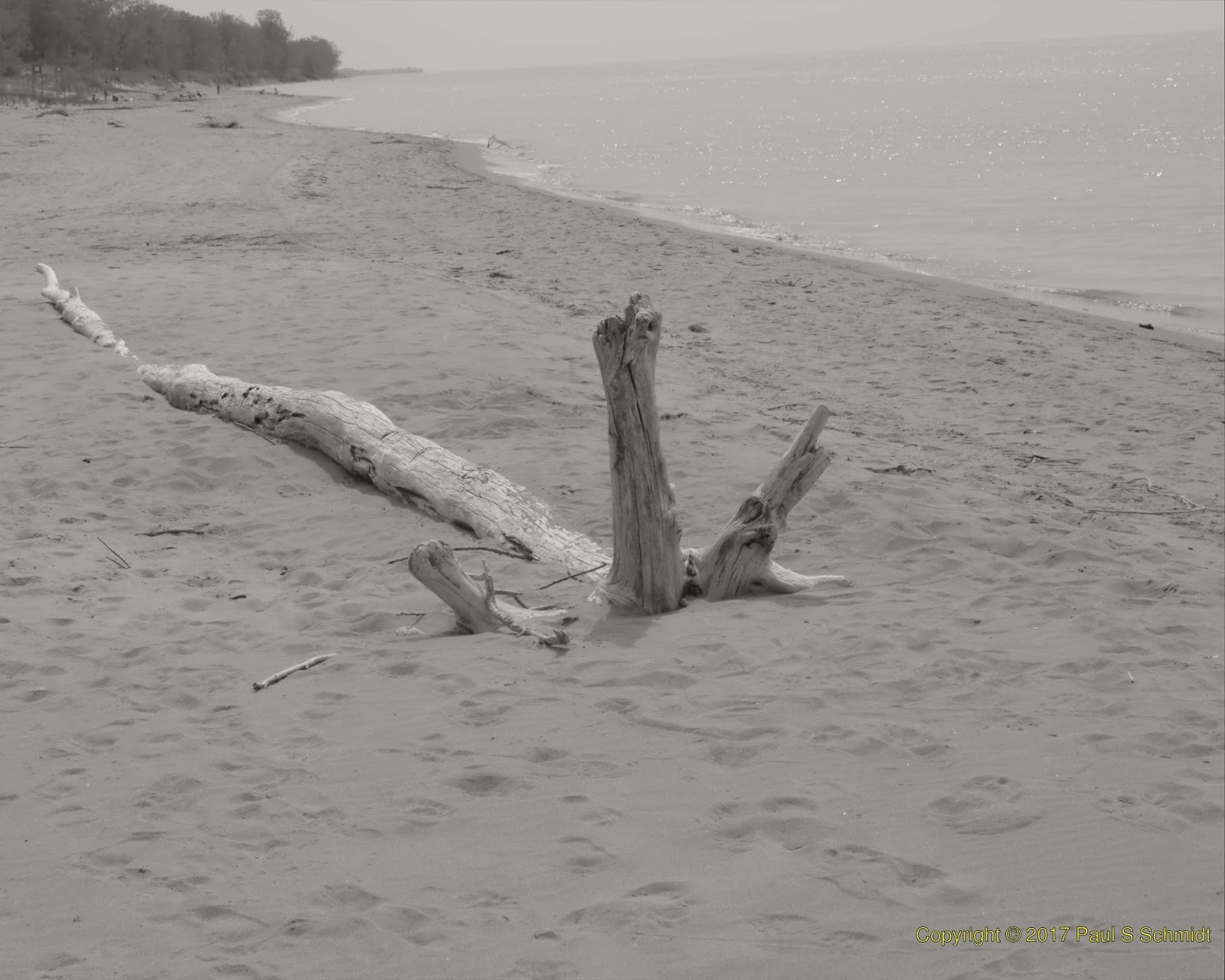
This weeks image is
some driftwood from a beech from last year.
Sunday, February 25, 2018
Preparing the bicycles for spring
Preparing the
Bicycles for Spring
You need to do some
work on your bicycles in preparation for a new season, some of this
can and should be done before you start riding for the springummer.
There are two kinds of work that can be done. First is a rebuild,
this is done about every 7-10 years, it requires striping everything
down, you basically disassemble and clean everything, replacing parts
that are consumable, brake pads, cables, tires and tubes, hand grips
or tape, chain, sometimes it even involves painting. I’m not going
into this, year as it’s quite involved, the road bike needs to be
done next winter, and I may do a series on it. Most years you do
more inspection and adjustment then anything else.
First you inspect
the bicycle, you’re looking for things that may need work, you air
up the tires to the proper pressure, do they hold pressure? You
inspect all of the cables, do they run smooth, any nicks or rust, any
cables that don’t run smooth or show rust, should be replaced. I
don’t use fancy expensive cables, I find inexpensive ones work just
as well, put a layer of grease on them before feeding them through
the housings, and they work quite well. Use a sharp pair of diagonal
wire cutters, and then put an end on them. I often get out the
soldering iron, put a little solder on the cable about 3/4cm down
from where I want to cut it, to a little past, then after it cools,
cut through the soldered part. It doesn’t crush and gives a nice
clean end, rather then using cutters you can use a Dremel with a
cutoff disk.
 |
| A4100933 |
Brake pads should be
checked, if they are not used for a long time, they can get dry and
hard, you can use a little sand paper, and take the hard edges off,
although considering the importance of working brakes, and the fact
that they are not that hard to replace, and can be purchased for a
fairly low cost, if they are hard, your better to replace them.
Of tires and tubes, tubes are the easiest, simply add air, if they stay inflated, they are still good. However when replacing tires, I always use new tubes, if the old ones still work, then they get placed in the spares supply. Cheaper tubes tend to be thicker as well as heavier, so work better for regular riding, where as thin expensive tubes are lighter for racing. Tires should be inspected, if they show excessive wear or the threads, or cracking on the sidewalls, they should be replaced. Chains should be inspected, set a ruler beside the chain, if 1’ of chain measures more then 1/8” longer then it should be replaced, otherwise, simple lubricate it and run through all of the gears to make sure it is shifting well.
Of tires and tubes, tubes are the easiest, simply add air, if they stay inflated, they are still good. However when replacing tires, I always use new tubes, if the old ones still work, then they get placed in the spares supply. Cheaper tubes tend to be thicker as well as heavier, so work better for regular riding, where as thin expensive tubes are lighter for racing. Tires should be inspected, if they show excessive wear or the threads, or cracking on the sidewalls, they should be replaced. Chains should be inspected, set a ruler beside the chain, if 1’ of chain measures more then 1/8” longer then it should be replaced, otherwise, simple lubricate it and run through all of the gears to make sure it is shifting well.
This weeks image is
the Mountain bike, it's pretty much the same as this image.
Sunday, February 11, 2018
The bicycle fleet
After last posting, I
decided to move to bi-weekly posting, and this is for a couple of
reasons, one is to actually allow myself the time to write the
postings, keep working on ImageFix and to reduce the number of actual
topics I need to come up with.
So this week I will
attack the bicycle fleet, I actually have two bicycles, they are
quite different beasts, at least they started out that way. First
is the 2004 Norco Bushpilot. This is designed as a mountain bike or
all terrain bike. 8 speeds in the rear and 3 in the front, although
it’s called a 24 speed, it’s really 8 speeds in 3 ranges, Low
range is used for going uphill, the middle range on the flats, and
high range going down hill. It’s not a particularly fast bicycle,
but that may have more to do with the “motor”, more then anything
else. It’s a little on the heavy side, and passed the half
century mark more then half a decade ago…. The bike needs some
work, suspension forks are made for 70kg riders, not 100kg+, so it
needs to be replaced or repaired, and they can’t really be
repaired. Not only is the motor heavy, so is the bicycle, it’s
about 16kg.
 |
| A4000186 |
The other bicycle,
is quite different, built by Raleigh in Canada, at their Waterloo,
Quebec plant in 1975, it’s a classic style road bicycle, it’s
built for speed, it has six gears in each of two ranges. These are
controlled by manual down tube shifters, thinner tires, and 700C
aluminum wheels running Presta tubes, the gearing is quite high, it’s
a bike for August when you are already in cycling shape, not when
your just coming out of Hibernation, and are at “winter” weight.
All decked out, this bike is around 12kg.
The Raleigh was being tossed out by a neighbour, so I essentially got it for free. I completely disassembled the entire bicycle, then reassembled it, replacing some parts like brake pads, cables, cable housings, tires and tubes. The image this week, is the Raleigh upon completion of the rebuild, later the same summer I changed out the shifters, then replaced the 27” rusty chrome wheels with some 700C aluminum ones. This weekend when it’s forecast to snow for 4 solid days, thinking about bicycles and getting out to ride, seems a long way away, but it isn’t. Another month I expect the Norco to see the sun the first time since last fall.
The Raleigh was being tossed out by a neighbour, so I essentially got it for free. I completely disassembled the entire bicycle, then reassembled it, replacing some parts like brake pads, cables, cable housings, tires and tubes. The image this week, is the Raleigh upon completion of the rebuild, later the same summer I changed out the shifters, then replaced the 27” rusty chrome wheels with some 700C aluminum ones. This weekend when it’s forecast to snow for 4 solid days, thinking about bicycles and getting out to ride, seems a long way away, but it isn’t. Another month I expect the Norco to see the sun the first time since last fall.
Sunday, January 28, 2018
My Custom Software introducing Imagefix
his week is going to
be unusual, in that I am heading a different direction, entirely.
As an old computer
geek, I realized the other day, I have been working with or playing
with computers for 40 years, about the same amount of time, I have
been playing with cameras. Since I have spent much of that time,
programming computers, when I can’t find the appropriate tool, I
write one. This usually starts as a sketch in code, that is quick,
dirty and ugly from a code perspective. Then I clean that up and
turn it into a proper program.
Such was the issue a
few years ago, I wanted a tool that would do a few things, in a
manner that would be consistent, in other words if I wanted a certain
tone, I wanted to just indicate it, rather then needing to remember
how I did it the last time. There were also things like adding a
watermark, I want it to be the same each time, tools like Gimp and
Photoshop are great, but you need to keep notes, if you want things
applied in a consistent manner, especially when other features may
not be consistent each time.
 |
| A3700146 |
So, because of this
desire, I wrote a program to do this. I called it Imagefix,
eventually I hope to make it publicly available, but alas not yet. I
am not quite sure how I want to have the finished product, right now
it’s a collection of command line parameters, but I might switch to
using a windowed system, where there is a dialog box that you select
the options with and it poops out the results in another file.
Realistically I would like it to be both, which could be one program, that if you pass it command line options, it assumes you want text mode, and if you don’t you want graphical mode. This is all stuff I need to decide in the next month or so. Eventually it will also need to be more platform agnostic, either it will need to be rewritten in a language like Python or Java, most likely Python, or will need a generic build process, for the current C++ version, other then the Gnu Make that I use right now. I expect a Linux only Beta by summer, and possibly something that is packaged ready for the public in a year.
Realistically I would like it to be both, which could be one program, that if you pass it command line options, it assumes you want text mode, and if you don’t you want graphical mode. This is all stuff I need to decide in the next month or so. Eventually it will also need to be more platform agnostic, either it will need to be rewritten in a language like Python or Java, most likely Python, or will need a generic build process, for the current C++ version, other then the Gnu Make that I use right now. I expect a Linux only Beta by summer, and possibly something that is packaged ready for the public in a year.
This weeks image is from some woods in 2007, don't remember anything about it.
Sunday, January 21, 2018
Why I use a Linux Computer
I originally built
my computer in 2007, using what then were decent reasonably up to
date components. However I didn’t want to pay for Microsoft
Windows, a platform that I had been working with off an on since
Version 3.0 some 27 years ago. As a computer geek, and not wanting
to spend several hundred dollars for an operating environment I
didn’t particularly like, since it would have been Windows XP
anyway….. That would have required several large hardware upgrades
along the way.
I remembered using
Linux before, when operating systems came on a whole series of
diskettes, I at one time had the 10 or so disks for Windows 3.1 and
the 20 or so for OS/2 and I think Slackware which came in at 15 or
so. So in building my computer I downloaded a couple of new Linux
versions, Ubuntu and Fedora. I later settled on Fedora, most likely
Fedora 8 (Werewolf), it’s currently running Fedora 27, which is the
latest release, and still runs fine on my decade old hardware. Yes
it has had a memory upgrade from 2GB to 4GB, the original on-board
video chip was updated to a more modern video card, and it’s
originally 150GB hard drive, was upgraded to a 512GB and then a 1TB
drive. It had some case fans added, and an upgrade to the CPU
cooler.
So why not a Mac? There is nothing a Mac can do, that this machine can’t, except maybe run some Microsoft software, where there are just as good, if not better alternatives. For photography there are some heavyweights, like GIMP. There are also for old computer guys like me amazing visual libraries like ImageMagick and GraphicsMagick, for programmers to be able to build software modules, while these modules are often available for Mac and Windows, the software that ties them together is more complex and harder to use. Where Linux which is a variation on the theme of Unix makes these tools much easier to use.
In the early days, there was a lot of hardware that would not work, and many of the installers were horrible, but this has all changed in the 20 years or so, since I first saw Linux. Most hardware works out of the box, even a Microsoft Webcam that I have worked out of the box. Installers are much nicer now, with much of the installation process being automatic, it’s not uncommon for a machine to boot into the installer, then install everything and reboot into the completed OS at the end. If you have an older computer, and Windows will not run on it anymore, try Linux; you might like it.
So why not a Mac? There is nothing a Mac can do, that this machine can’t, except maybe run some Microsoft software, where there are just as good, if not better alternatives. For photography there are some heavyweights, like GIMP. There are also for old computer guys like me amazing visual libraries like ImageMagick and GraphicsMagick, for programmers to be able to build software modules, while these modules are often available for Mac and Windows, the software that ties them together is more complex and harder to use. Where Linux which is a variation on the theme of Unix makes these tools much easier to use.
In the early days, there was a lot of hardware that would not work, and many of the installers were horrible, but this has all changed in the 20 years or so, since I first saw Linux. Most hardware works out of the box, even a Microsoft Webcam that I have worked out of the box. Installers are much nicer now, with much of the installation process being automatic, it’s not uncommon for a machine to boot into the installer, then install everything and reboot into the completed OS at the end. If you have an older computer, and Windows will not run on it anymore, try Linux; you might like it.
 |
| A4400202A |
This weeks image is
a cropped version of one from 2014 of a Red Wing Blackbird, this was
actually taken in High Park in Toronto, during the Cherry Blossom
time, so June. I often save crops, and assign them a letter after
the usual number, such as this one.
To quote the words of the mighty Porky Pig:
That's all folks
That's all folks
W.
Sunday, January 14, 2018
Camera Filters and Accessories.
Once upon a time,
photographers had dozens of filters, for black and white, the most
common were Red, orange and yellow, for colour we often had filters
that allowed daylight film to be used in indoors (80A a blue fliter)
and the 85 or 85B (orange), which allowed Tungsten film to be used
outside. Then there were filters that could be used with both, such
as the 1A, UV, ND filters, graduated ND and there were even FL-D and
FL-W which could be used with fluorescent light, to take away it’s
greenish tinge.
Many of those filters are not needed anymore, digital cameras can be setup to use white-balance, where the camera can work around colour casts. Cameras can automatically adjust “film speed” to negate the need for ND filters, and HDR (High Dynamic Range) has replaced the graduated ND. Cameras and software can replicate all kinds of effects.
There are a few we still use, the Polarizing filter can remove glare from an water or a window, to allow the camera to see through shiny surfaces. A Skylight (1A) filter can still remove the haze you see in some telephoto images. It can also be handy, as a lens protector, it’s much better to scratch the front of a $30 filter, then a $300 or $3,000 lens. You do need to check them once in a while, to make sure that you haven’t damaged the filter, and they should probably not be tight on the lens at all times.
Many of those filters are not needed anymore, digital cameras can be setup to use white-balance, where the camera can work around colour casts. Cameras can automatically adjust “film speed” to negate the need for ND filters, and HDR (High Dynamic Range) has replaced the graduated ND. Cameras and software can replicate all kinds of effects.
There are a few we still use, the Polarizing filter can remove glare from an water or a window, to allow the camera to see through shiny surfaces. A Skylight (1A) filter can still remove the haze you see in some telephoto images. It can also be handy, as a lens protector, it’s much better to scratch the front of a $30 filter, then a $300 or $3,000 lens. You do need to check them once in a while, to make sure that you haven’t damaged the filter, and they should probably not be tight on the lens at all times.
 |
| A4100108 |
Filters were one of
those accessories we all had, and while you need a lot fewer now,
some of the other accessories can still be handy. If you like using
big telephoto lenses, then a tripod can be critical, if you like
really sharp images, the tripod can work there too. For compact
use, nothing beats a monopod, which is basically a 1 legged tripod,
you attach the camera, and use your own body as the other two legs.
An accessory that goes well with the tripod, is a remote release, this allows you to trip the shutter without touching the camera, in the old days this was either a cable release that threaded onto the shutter release. There were also pneumatic versions, where you had a similar screw on unit, attached to a cylinder with an air line and a squeeze bulb on the end. Many cameras still have a B shutter speed, where holding the release allows for, the shutter remaining open until you release it. With modern electronic cameras there is often an accessory socket, that takes a electronic release. Some of these have a “hold” option. I recently added one of these for my T5.
The one best accessory for any camera that uses specialized batteries, is a spare battery, name brand batteries can be expensive, third party work-a-likes can be much cheaper and work just as well.
An accessory that goes well with the tripod, is a remote release, this allows you to trip the shutter without touching the camera, in the old days this was either a cable release that threaded onto the shutter release. There were also pneumatic versions, where you had a similar screw on unit, attached to a cylinder with an air line and a squeeze bulb on the end. Many cameras still have a B shutter speed, where holding the release allows for, the shutter remaining open until you release it. With modern electronic cameras there is often an accessory socket, that takes a electronic release. Some of these have a “hold” option. I recently added one of these for my T5.
The one best accessory for any camera that uses specialized batteries, is a spare battery, name brand batteries can be expensive, third party work-a-likes can be much cheaper and work just as well.
Sunday, January 07, 2018
Shooting in snow.
Snow
can be both a blessing and a curse. It
can be a blessing, because it covers a multitude of dirt, garbage,
dog poop and other sins that make your image look messy and
complicated. It can be a curse, when your exposure is off
and most of your image is a white blob.
The
reason you get a white blob, is that you have
part of your image that is too bright, typically the snow. This is
usually referred to as a blown highlight, by the same token if it’s
on the dark parts of the image it’s a blocked shadow. If you want
some texture in your snow, you can intentionally under expose the
image, which on most newer DSLR cameras can be done by setting the
exposure to be 1 stop under. You need to be careful though that by
underexposing the highlights, you don’t block up the shadows. If
that is the case, you can always bracket your exposure taking one two
stops under exposed, one at proper exposure and one over exposed,
then use an HDR technique called tone mapping to combine the 3
images, the software that does this, needs a lot of computer
horsepower, so you don’t want to do it on every image, with an
older computer. Some cameras can be set to automatically bracket the
exposure.
Few
images need that much alteration, and
often just taking the exposure and dropping a stop, will give the
snow some detail, without affecting other parts of your image too
much. Focus has some to do with it, if your depth of field leaves
the snow out of focus, your going to get a white blob anyway, so you
might just let it go.
 |
| A4100035 |
Since
most of my stuff is B&W, and there is a decided lack of colour, I
sometimes add a little to make things interesting, through the use of
toning. This is digitally simulated these days, for a specific look.
If you want an image to look warm you apply a brownish tone, like
the sepia tone of 19th and early 20th century
images. If you want a cold feel, you use a bluish tone. This weeks
image has a very light bluish tone, intended to make it’s snow
appear colder then it normally would. Different metals can be used,
including iron, copper and gold, the colour of the metalic image
doesn’t appear to be similar to the colour of the polished metal.
This weeks image has a slight blue tone, to make it feel colder then
it would as a standard black and white image.
Sunday, December 31, 2017
Plans for the New Year
I
know I got overly busy at the end of this year, and had to go on
hiatus during the Christmas season. I will try to get a few ahead, so
that we don't have to take a number of weeks off at the end of the
year. We may also start doing some bicycle related stuff, as that was
part of the original concept here. There may be a couple of those
over the winter, but expect that to get going more once bicycle
season returns, which around here is April to May. I need to get all
the bicycles tuned up, and get riding again.
The
plan is to plan articles 2 months ahead, and then writing them a
month ahead, so it only takes a short while on a weekly basis to
post, and if I have something like a vacation coming up, or a busy
period, I can queue a few weeks up, and let the scheduler sort them
out. I might consider an income mechanism, either ads on the site or
a Patreon, like mechanism. This would allow me some investment, like
a domain, and would allow me to put more time into it, and to write
longer articles with more detail.
This
past year was kind of a failure, I got going again, and then went on
hiatus, because I was not prepared for what was going to happen at
the end of the year. Mistakes are not the problem, it’s when you
don’t learn from your mistakes, that you have a problem. What I
learned was that the weeks leading up to Christmas can be extremely
busy, both personally and at work, so you need a lead time, to get
stuff done. In order to prevent those same issues in 2018, I have
planned articles to the beginning of February at this point, and
would like to get planned up to the beginning of March this week, get
January 7th in the bag, and January 14th
outlined. January 7th will be about shooting when there
is snow about. I really would also like articles to be longer, at
least 400 words, a few in 2017 fell far short of that.
 |
| B3300032 |
In
case your wondering, I actually write the text using LibreOffice,
which has better spell checking, and
text tools. I then do the images separately and have them ready, so
I can pump the whole thing into Blogger, from a couple of files, then
the only issue is to do the layout and it’s done.
This weeks image is an old favourite from back in 2003, it's a winter shot on film, I think using the TC as it's originally from a colour negative.
Hope you had a merry Christmas, and all the best in 2018!
W
W
Wednesday, November 15, 2017
Don't put your camera away for the Winter
While most people who ride bicycles will put them away, and people swap from roller skates to ice skates, yeah I know rollerblades replaced roller skates, but roller skates does rhyme better.... Your camera doesn't need to go away with them.
There are a couple of things you do need to consider when it's cold out though. First of all, batteries don't like cold, so you may want to keep a second camera battery in an inside pocket, even a cold battery when it's brought into a warm place, can regain some power. If your camera and batteries are older, than you may want to replace the batteries with new ones. I always put the date on a battery when it enters service, as I can have several batteries that look the same, and not remember which one is the oldest.
Second of all, cameras don't like wet, cold air holds less moisture than warm air, a cold surface will chill the air immediately next to it, so don't open your camera bag until it has had time to warm up. This will keep moisture from condensing on the camera and lenses, it will condense on the outside of the bag instead. The best cold weather camera hat I ever had, was the old Konica TC, the mechanical parts didn't seem to mind the cold, and it worked fine using Sunny 16 type exposure, even with colour negative film. The FC-1 hated the cold, the 300D didn't seem to mind it, except when the batteries were old, they tended to go flat fairly quickly. LCD screens are okay to about -20℃ or about -4℉, although, you can keep a chemical hand warmer in your bag, and just take the camera out, make your shots, and back into the bag, or keep the camera inside clothing.
The image this time, is from the great ice storm of December 2013, when most of southern Ontario was covered in ice, which led to wide scale power outages, although the storm occurred on December 20th, it was New Years before the power was on everywhere. About a week before we moved, the new house had a total outage of maybe 10 minutes, the old one was out for over a week. This little twig got a coating of ice.
I hope to get another posting in, this month, will see you then. Not sure about December yet, December can be brutally busy, I will try to get in two, but may only get in one.
See you then, W.
There are a couple of things you do need to consider when it's cold out though. First of all, batteries don't like cold, so you may want to keep a second camera battery in an inside pocket, even a cold battery when it's brought into a warm place, can regain some power. If your camera and batteries are older, than you may want to replace the batteries with new ones. I always put the date on a battery when it enters service, as I can have several batteries that look the same, and not remember which one is the oldest.
Second of all, cameras don't like wet, cold air holds less moisture than warm air, a cold surface will chill the air immediately next to it, so don't open your camera bag until it has had time to warm up. This will keep moisture from condensing on the camera and lenses, it will condense on the outside of the bag instead. The best cold weather camera hat I ever had, was the old Konica TC, the mechanical parts didn't seem to mind the cold, and it worked fine using Sunny 16 type exposure, even with colour negative film. The FC-1 hated the cold, the 300D didn't seem to mind it, except when the batteries were old, they tended to go flat fairly quickly. LCD screens are okay to about -20℃ or about -4℉, although, you can keep a chemical hand warmer in your bag, and just take the camera out, make your shots, and back into the bag, or keep the camera inside clothing.
 |
| A4300103 |
The image this time, is from the great ice storm of December 2013, when most of southern Ontario was covered in ice, which led to wide scale power outages, although the storm occurred on December 20th, it was New Years before the power was on everywhere. About a week before we moved, the new house had a total outage of maybe 10 minutes, the old one was out for over a week. This little twig got a coating of ice.
I hope to get another posting in, this month, will see you then. Not sure about December yet, December can be brutally busy, I will try to get in two, but may only get in one.
See you then, W.
Sunday, October 29, 2017
Posting less frequently.....
This is a busy time of year, with a lot of stuff happening, so I will be moving to a less frequent posting schedule.
Voluntary blogs run into the problem of, you eventually run out of things you want to say, on a regular basis, this leads to you heading in two directions, you either move to a less frequent schedule, or you add some off topic stuff, like politics. Since this isn't a paid site, and it doesn't currently derive income from advertising, I am moving to a less frequent schedule. I will try to post something a couple of times a month, one at the end of the month, the other in the middle, in January when there is more time available, I may post mote.
Thanks,
W
Voluntary blogs run into the problem of, you eventually run out of things you want to say, on a regular basis, this leads to you heading in two directions, you either move to a less frequent schedule, or you add some off topic stuff, like politics. Since this isn't a paid site, and it doesn't currently derive income from advertising, I am moving to a less frequent schedule. I will try to post something a couple of times a month, one at the end of the month, the other in the middle, in January when there is more time available, I may post mote.
Thanks,
W
Sunday, October 22, 2017
Professional Slide shows in the old days
Last week we looked at digital slide shows, and you could have music and pre-built narration and everything. This has been possible since at least the early 1950's, but was much more difficult. You needed a tape player and two projectors, the slides would alternate from one projector to the other, professional grade slide projectors could be purchased that had a fade capability, as one faded out, the other faded in. This could be based on time, or using an audio tone with a special remote. A tone would then operate the projector, some people used separate audio tracks, one was connected to the sound system, the other to the projectors, so the tone was not audible. Of course if you dropped the tray of slides, then you needed to start over, although smart people would number the slides, for example 1-14 would be in tray 1, slide number 14.
Many people in building such setups would, have copies made of the slides, and only the copies would be projected, as the intense light passing through the slides would cause them to fade over time, plus you protected the original slides from damage in handling. Projectors setups needed to be perfectly registered so the images would line up. A target slide could be placed in each projector and then they would be lined up, and re-targeting would be required for each venue as a change in the distance from projector to screen would throw off the targeting.
All to say, it's a little like digital printing, it's easier and often faster then the old days, but it's incredible what was possible in the bad old days.
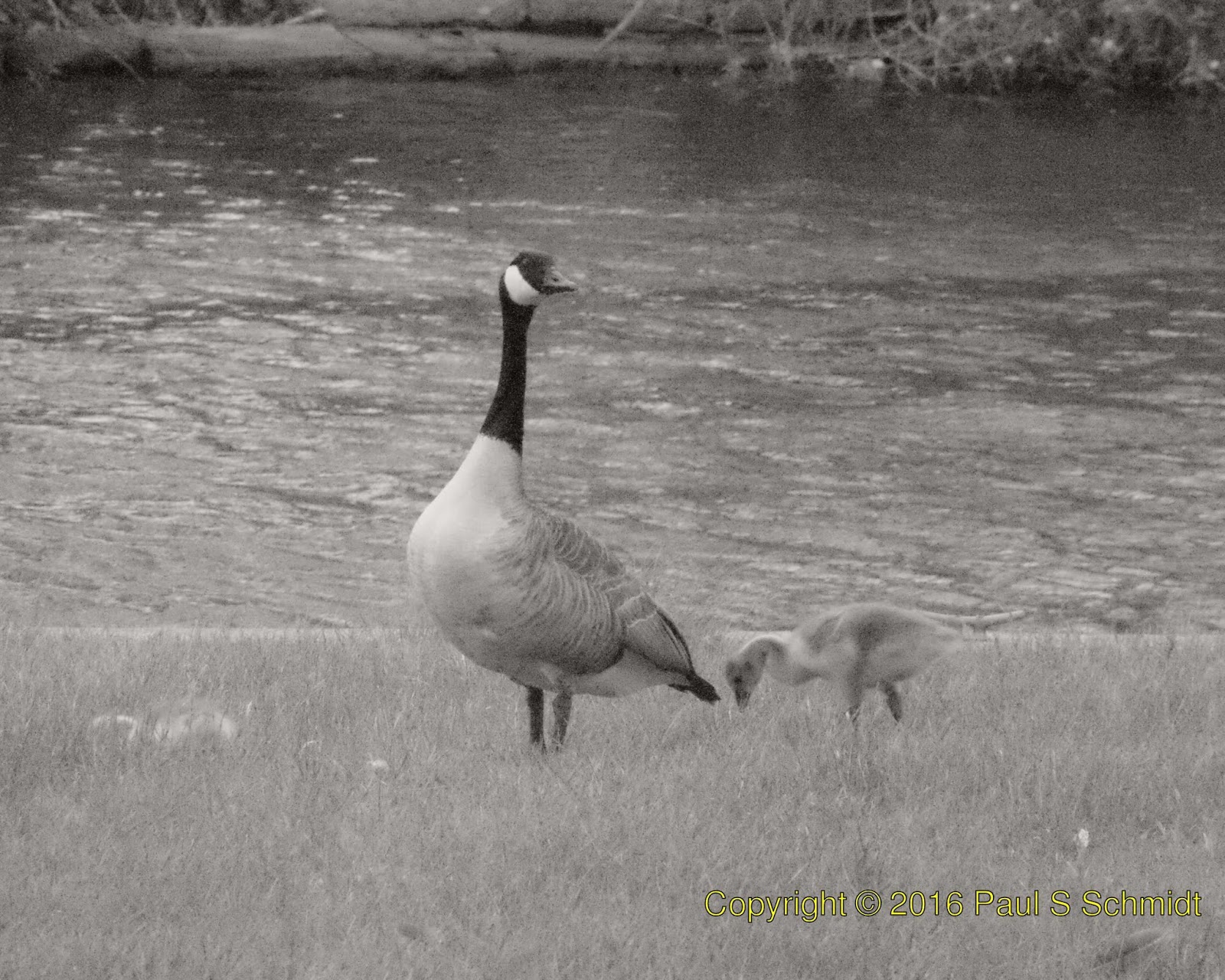
This weeks image is from last year, of a mother goose and her gosling. If I recall correctly this was taken at the Toronto Islands. You almost lose the gosling in the grass, but not quite.
I know, quite short this week, but that's all for now.
W
 |
| A4600733 |
All to say, it's a little like digital printing, it's easier and often faster then the old days, but it's incredible what was possible in the bad old days.
This weeks image is from last year, of a mother goose and her gosling. If I recall correctly this was taken at the Toronto Islands. You almost lose the gosling in the grass, but not quite.
I know, quite short this week, but that's all for now.
W
Sunday, October 15, 2017
Slide shows
We can do a lot better digitally these days. software like Openshot can be used to create wonderful slide shows, you can give each slide a certain amount of time, say 10 seconds, then use a professional style fade or wipe to the next image, rather than a black out. A fade is where one image gradually replaces another and a wipe is where one seems to roll over the other. If using wipes, don't use too many different ones, or you can make your audience "sea sick". You can use a simple microphone to add commentary over the slides, a good way to do this, is to watch the pictures a few times, and write some notes, as to when you want to speak, and what you want to say, then script the show, if using a microphone, you want it on a stand, about 30cm away from where you're sitting. You can also add a music track, don't use songs from the radio or a CD, as it creates copyright issues, there are places to get music for this, Youtube has an audio library of songs you can use, the ideal is to load the commentary into software like Audacity, then mix the tracks, for example you can reduce the volume of your commentary when not speaking, to remove background noise, or have the music lower below your speaking, and then higher when you're not speaking. If using several songs, your can "balance" the volume between tracks that were recorded at different levels. Once the audio track is completed, you can add it to the video. You can also add titles to your show.
 |
| A380068 |
This little guy resting on a not quite open rose from 2008 will need to do. I think it was a backyard shot, as we often have flowers in the back yard and they are typically easy to obtain.
|
I think that is all for this week,
W.
Sunday, October 08, 2017
A week off....
Occasionally I will be taking a week off, it is Thanksgiving here in Canada, so I will be taking the week off. See you back here next week. The next break will be 2 weeks at Christmas time....
Sunday, October 01, 2017
Some newer stuff
Sort of a continuation of last week, we have a series of images, one or two from each year from 2011 to 2017. Each of these images has some meaning, as I try to remember what I was working on, when I took the image. Some of these will have pretty exact descriptions. There will be a slightly different format this time, I made the pictures a little larger.
This first one was taken off a small road that is near Wiarton, ON. It can be best described by what it actually is, an honest to goodness swamp. The water level is about 3cm below the road, the ground is about 10cm below the road. In the spring, the road floods and the town puts out signs that the road will be underwater. It's a gravel road, called Zion Church Road. The flooding actually doesn't hurt it. When it dries out, the stone dust and gravel hardens so that it's harder then concrete. Never knew when I lived there that this is actually called the Gleason Brook Management Area.
This next one was taken on Flowerpot Island, although known mostly for it's rock formations that look like giant flower pots, there is a lighthouse and I found this guy near the lighthouse where there is a small cafe that had some lilac bushes near it. This guy was just chilling on a leaf. I did for the record take some pictures of the flower pots. This is part of the Fathom Five National Park, which is just off The Bruce Peninsula from Tobermory, There are a number of boats that ferry people to Flowerpot, leaving from Tobermory, some of them are cruise type boats that cover portons of Fathom Five.
At one point in things I decided I didn't want to carry the big 300D everywhere and picked up a cheap little point and shoot, a Canon A810. I find that as a camera it is dreadfully slow. Images were not that bad, providing it was fairly bright daylight. Many of these little cameras have that problem, a very limited range of lens stops, mean that if light is a little lower, you end up with longer then you would like exposures. IIRC This was taken at Lion's Head a small village north of Wiarton, that is part of the town of Northern Bruce Peninsula, which like South Bruce Peninsula was a town that was a merger of a number of smaller places. Hard to tell but the temperature on this day was -10C, and yes that IS open water.
After we moved back to Toronto, in the spring is the cherry blossom festival, one of the trails actually leads to a swan nesting area, there are a number of ducks and other waterfowl that nest there. I believe that in 2014, the cherry blossoms were a little late, but the Swans and other birds were pretty much on regular schedule. This is a mute swan, and they are not native to North America, but rather from Europe. They have had large increases in population, and in North America are consider an invasive species. They still take a nice image though.
This next one is actually a film image taken with the FC-1. I know it was the FC-1 because the TC was fully retired by this point. Film would be Fuji Superia looks like 200, as I had a bunch of rolls in the freezer and it's a colour image. I don't remember much about it, I think I had a few things on this roll, and I think I was just using it up at this point. Currently if I decide to shoot some film, I need to find some, and a lab to process it, and that would be a big hassle. I actually planned to sell the camera a couple of years ago, but it's resale value is just about zero, so I held onto it. This is really quite sad, the camera is nearly 40 years old, and still works amazingly well, just it's not worth anything anymore. I think on this one I used an old numbering system, because I forgot I had changed it.
While cameras generally don't like getting wet, cloudy days give a more even light, and sometimes a natural watering adds a whole new dimension to an image. I think it does here, especially since the leaves actually appear dry. This is a little false though, because there is a massive cedar hedge that shelters these leaves somewhat, so they probably are dry, but the flower was further out, and got wet. This one was easy to find, it was actually in my backyard. Backyard flowers in large flowerpots can make great images, because you can turn the flowerpot in order to get a better image if you can't put the camera in the right place.
I debated for a while about actually publishing this one in colour, as the light part of the wings is a bright blue, but the blue would draw the eye away from everything else. You might not notice the dots on the wings or the veins in the wings, if all you see is bright blotch of blue. It's an image I might just try and do in colour at another point, and see what people think.
I intentionally didn't include this years as the year is continuing on. This is about all for this week, and we may just revisit this butterfly to see if it really is better in monochrome or colour.
W
 |
| A4100443 |
 |
| A4200162 |
This first one was taken off a small road that is near Wiarton, ON. It can be best described by what it actually is, an honest to goodness swamp. The water level is about 3cm below the road, the ground is about 10cm below the road. In the spring, the road floods and the town puts out signs that the road will be underwater. It's a gravel road, called Zion Church Road. The flooding actually doesn't hurt it. When it dries out, the stone dust and gravel hardens so that it's harder then concrete. Never knew when I lived there that this is actually called the Gleason Brook Management Area.
This next one was taken on Flowerpot Island, although known mostly for it's rock formations that look like giant flower pots, there is a lighthouse and I found this guy near the lighthouse where there is a small cafe that had some lilac bushes near it. This guy was just chilling on a leaf. I did for the record take some pictures of the flower pots. This is part of the Fathom Five National Park, which is just off The Bruce Peninsula from Tobermory, There are a number of boats that ferry people to Flowerpot, leaving from Tobermory, some of them are cruise type boats that cover portons of Fathom Five.
 |
| D4300158 |
At one point in things I decided I didn't want to carry the big 300D everywhere and picked up a cheap little point and shoot, a Canon A810. I find that as a camera it is dreadfully slow. Images were not that bad, providing it was fairly bright daylight. Many of these little cameras have that problem, a very limited range of lens stops, mean that if light is a little lower, you end up with longer then you would like exposures. IIRC This was taken at Lion's Head a small village north of Wiarton, that is part of the town of Northern Bruce Peninsula, which like South Bruce Peninsula was a town that was a merger of a number of smaller places. Hard to tell but the temperature on this day was -10C, and yes that IS open water.
 |
| A4400206 |
After we moved back to Toronto, in the spring is the cherry blossom festival, one of the trails actually leads to a swan nesting area, there are a number of ducks and other waterfowl that nest there. I believe that in 2014, the cherry blossoms were a little late, but the Swans and other birds were pretty much on regular schedule. This is a mute swan, and they are not native to North America, but rather from Europe. They have had large increases in population, and in North America are consider an invasive species. They still take a nice image though.
 |
| C4400105 |
This next one is actually a film image taken with the FC-1. I know it was the FC-1 because the TC was fully retired by this point. Film would be Fuji Superia looks like 200, as I had a bunch of rolls in the freezer and it's a colour image. I don't remember much about it, I think I had a few things on this roll, and I think I was just using it up at this point. Currently if I decide to shoot some film, I need to find some, and a lab to process it, and that would be a big hassle. I actually planned to sell the camera a couple of years ago, but it's resale value is just about zero, so I held onto it. This is really quite sad, the camera is nearly 40 years old, and still works amazingly well, just it's not worth anything anymore. I think on this one I used an old numbering system, because I forgot I had changed it.
 |
| A4500568 |
While cameras generally don't like getting wet, cloudy days give a more even light, and sometimes a natural watering adds a whole new dimension to an image. I think it does here, especially since the leaves actually appear dry. This is a little false though, because there is a massive cedar hedge that shelters these leaves somewhat, so they probably are dry, but the flower was further out, and got wet. This one was easy to find, it was actually in my backyard. Backyard flowers in large flowerpots can make great images, because you can turn the flowerpot in order to get a better image if you can't put the camera in the right place.
 |
| A4600177 |
I intentionally didn't include this years as the year is continuing on. This is about all for this week, and we may just revisit this butterfly to see if it really is better in monochrome or colour.
W
Sunday, September 24, 2017
Why I like Nature Photography
Much of the modern world is stressful, and that stress builds up in our bodies and in our minds, and this needs to be at times released. For me, I find that being in nature, a good way to relieve that stress, and it is something I try to do a few times a year. Often city dwellers, here in Toronto, don't have to go all that far to find nature, there are a number of large parks in the city, where you can find nature, often in your own neighbourhood.
This next image is another interesting one, it was taken using the Konica FC-1 on Ilford
FP-4 I think it was in Algonquin, as there is a similar image below that was from the same time period that was in Algonquin. It has a bit of a dreamy effect, which is why I like it. It's actually the first image on the roll, with a frame number of 0. An old cataloguing system I used divided film into roll and frame numbers, then I added a different mechanism for digital, and a bunch of years ago, I moved to a single system, leaving the old roll numbers in the negative book, and referencing them in the EXIF data. Which is how I get some of the data (like camera and film type) without needing to dig out the negatives.
This is an odd one, it was taken with a Point & Shoot Camera that belonged to my wife, she took thousands of images with it, in Bolivia, during a trip there, I borrowed it, to see how digital might work for me, and it did, so I bought the 300D at Christmas that year. Again it has a dreamy, kind of feel, partly because it was in the morning of a rather damp day, and there was a lot of moisture in the air. The day later dried up, and by evening it was very nice out. I probably took more shots on this day, then I did the rest of the year. My Brother-in-law was on this trip, and we left at 5am and were at the park a little after 8, and decided to hit the trails before things got busy, these images were taken around 9am.
We were there for a long time, in fact we were still shooting at sunset, and the next image was taken at sunset on the same day, I think we got home after 11PM. By sunset it was starting to cloud over again, the best sunrise and sunset photos need some clouds, and sunlight poking through the cloud deck, are pretty much the ideal. One of the problems point and shoot cameras, is that you have to take whatever the camera gives you. I got kinda lucky here, in that it blocked up the shadows, rather then exposing for those and burning the highlights. I used the digital for this, because I had taken about 4 rolls of film, and had run out. With some room left on the little digital. It's one of the benefits of digital, a couple of cards can hold a lot of images. If I were to have done it again with film, I would have taken about twice as much.
This is a winter one, taken near Ashbridge's bay, in Toronto. In early to mid winter, Lake Ontario is warmer than the shoreline, and as waves strike the shore, some water is thrown up as tiny droplets, as soon as it hits the land, which is much colder, it freezes. This was taken with the 300D, which strangely enough didn't mind the cold as much as the FC-1, which was about 25 years old at the time. This was taken on a very cold, windy and blustery day, even though the timestamp says it was March 3rd.... It was still solidly in winter, and probably around -10C.
I often tone summer images slightly sepia, and winter ones, slightly cyan, which I did in this case, the bluish tone, makes the image feel colder, where as sepia is a slight warming effect.
This is another one from G Ross Lord park, which has a creek running through it. Again the 300D, zoomed in as far as it can with the kit lens. It's a fall photo, being around this time of year, it's a good imaging time, in that the temps tend to be a little cooler, not this year it's 30℃ as I type this. Trees still are in nearly full leave, something that will not be the case in a couple of weeks. As I said earlier, it's been a while since I have been to this park, and I would like to visit again. This kind of image, is one I like, kinda messy, where it can be difficult to decide what the actual subject is. It could be the trees at the front, the ones in the back, or the water in the middle. It's actually supposed to be the water, but you could actually argue it's something else. You can view it 47 times, and decide it's something else each time.
Another winter one, the date on this one is Valentines day, there had been thin ice over the top of the lake, when the wind picked up, it was tossed into this messy pile on the shore. Again to offer a cold feeling I simulated the cyan tone, rather than the brownish sepia tone, I often use. A cyan tint in the film days, was commonly done using potassium ferricyanide, and was most commonly used in the production of blueprints. These days we can do the same thing, by shifting the colour balance in a RGB black and white image. Much less messy, and you can get the same result over and over again, where as bleaching and dyeing a print, will tend to give different results each time, without laborious notes.
Okay, the last one for this week, I am debating about doing a similar series for next week, that will consist of some newer stuff, or possibly even older stuff, as I have some going back to the start 40 years ago..... I suspect this is Limestone, which is fairly soft, and where water can eat away the stone in interesting patterns. It's Lake Ontario again, but in this case over by the Humber River bridge. What is strange is that although it appears almost a moonscape, there are massive condo's only 100m away or so, on the other side of a busy arterial road.
Most of these were taken within a 1/2 hour subway ride, or bicycle ride from where I was living at the time. Yes it does take a while to get to Algonquin, it's still possible to do as a day trip. So as we began, you can look at nature very close to home.
W
This is another multi-image posting, and these are all images taken between 2003 and 2010, I will add some commentary to these, where I have it, and where I took it, if I remember....
 |
| C3400017 |
This is the oldest image in this series, taken with the Konica TC on Agfa Vista 200 Colour film, it was taken of a "funny" tree in G Ross Lord Park in Toronto, I would bike through to the North End of the Park sit under this tree for a while, then head back to my home that was about 4km to the south. Not more than 200m to the East of this, is a large industrial plant, and 100m to the North is a busy Arterial road.
I have a few images of this tree, scanned on an Epson flat bed. You may notice that some of the copyright notices are larger and some are smaller, I need to change this, as the font is a fixed size, and it should be a percentage of the image size. So it's smaller on higher resolution images, and larger on smaller resolution images...
I have a few images of this tree, scanned on an Epson flat bed. You may notice that some of the copyright notices are larger and some are smaller, I need to change this, as the font is a fixed size, and it should be a percentage of the image size. So it's smaller on higher resolution images, and larger on smaller resolution images...
I don't know if this tree is still there, as it's been many years since I lived there, and it may have been cut down by now, there have been some big ice storms, and I don't think the bumps on the trunk made for a strong tree. Some day I need to return there and see, if it's still there.
 |
| B3600057 |
This next image is another interesting one, it was taken using the Konica FC-1 on Ilford
FP-4 I think it was in Algonquin, as there is a similar image below that was from the same time period that was in Algonquin. It has a bit of a dreamy effect, which is why I like it. It's actually the first image on the roll, with a frame number of 0. An old cataloguing system I used divided film into roll and frame numbers, then I added a different mechanism for digital, and a bunch of years ago, I moved to a single system, leaving the old roll numbers in the negative book, and referencing them in the EXIF data. Which is how I get some of the data (like camera and film type) without needing to dig out the negatives.
 |
| E3600021 |
This is an odd one, it was taken with a Point & Shoot Camera that belonged to my wife, she took thousands of images with it, in Bolivia, during a trip there, I borrowed it, to see how digital might work for me, and it did, so I bought the 300D at Christmas that year. Again it has a dreamy, kind of feel, partly because it was in the morning of a rather damp day, and there was a lot of moisture in the air. The day later dried up, and by evening it was very nice out. I probably took more shots on this day, then I did the rest of the year. My Brother-in-law was on this trip, and we left at 5am and were at the park a little after 8, and decided to hit the trails before things got busy, these images were taken around 9am.
 |
| E3600066 |
We were there for a long time, in fact we were still shooting at sunset, and the next image was taken at sunset on the same day, I think we got home after 11PM. By sunset it was starting to cloud over again, the best sunrise and sunset photos need some clouds, and sunlight poking through the cloud deck, are pretty much the ideal. One of the problems point and shoot cameras, is that you have to take whatever the camera gives you. I got kinda lucky here, in that it blocked up the shadows, rather then exposing for those and burning the highlights. I used the digital for this, because I had taken about 4 rolls of film, and had run out. With some room left on the little digital. It's one of the benefits of digital, a couple of cards can hold a lot of images. If I were to have done it again with film, I would have taken about twice as much.
 |
| A3700215 |
 |
| A3800139 |
This is another one from G Ross Lord park, which has a creek running through it. Again the 300D, zoomed in as far as it can with the kit lens. It's a fall photo, being around this time of year, it's a good imaging time, in that the temps tend to be a little cooler, not this year it's 30℃ as I type this. Trees still are in nearly full leave, something that will not be the case in a couple of weeks. As I said earlier, it's been a while since I have been to this park, and I would like to visit again. This kind of image, is one I like, kinda messy, where it can be difficult to decide what the actual subject is. It could be the trees at the front, the ones in the back, or the water in the middle. It's actually supposed to be the water, but you could actually argue it's something else. You can view it 47 times, and decide it's something else each time.
 |
| A3900139 |
 |
| A4000103 |
Okay, the last one for this week, I am debating about doing a similar series for next week, that will consist of some newer stuff, or possibly even older stuff, as I have some going back to the start 40 years ago..... I suspect this is Limestone, which is fairly soft, and where water can eat away the stone in interesting patterns. It's Lake Ontario again, but in this case over by the Humber River bridge. What is strange is that although it appears almost a moonscape, there are massive condo's only 100m away or so, on the other side of a busy arterial road.
Most of these were taken within a 1/2 hour subway ride, or bicycle ride from where I was living at the time. Yes it does take a while to get to Algonquin, it's still possible to do as a day trip. So as we began, you can look at nature very close to home.
W
Sunday, September 17, 2017
Camera Lenses
A Camera lens is a device that bends light, so that different light beams line up, preferably at the focal plane, which is where the film or sensor is located. When this is true, it is said to be in focus, the earliest cameras had a single lens. Since the film was so large in size, typically 4"x5", 5"x7", 8"x10", 11"x14" and 16"x20". These numbers were not magical, they were simply standard window glass sizes, in the days of plate photography. When sheet film came out, the same sizes were adopted. However we are getting off track, if your negative is 8"x10" (20cm x 25cm) you can make things larger, by contact printing on 4x5" paper.
Eventually they developed screw type lens mounts that allowed for changing lenses, and lenses of different sizes were developed. It was quickly discovered that if you made the focal length shorter, the angle of view got wider, which meant more would fit in an image at a given distance from the camera, and depth of field increased. News photographers would often use these benefits by fixing short lenses on their cameras. Unfortunately there are also a disadvantage, straight lines would appear curved, and perspectives would change, an item that was close to the camera would appear much larger then normal, and an item further away would appear much smaller. Photographers have used both of these traits to advantage.
By the same token longer lenses would have a narrower angle of view, less would fit in the image at the same distance, straight lines would not be affected, but the perspective changes would be reversed, flattening the image. Portrait photographers learned quickly that using a slightly longer than normal lens, was more flattering, with a 35mm camera 85mm - 100mm is about right. In the 1960's they developed the bayonet mount, which made lenses easier and faster to change. Unfortunately where with screw mount lenses nearly all camera's used the same 49mm mount, each bayonet could be a little different. You could no longer use a lens made by one manufacturer, on another makes camera. Although third party lens makers would quite often make lenses with different mounts on them, and one company Tamron made adaptall lenses which could be used with different makes of cameras, using different adapter rings.
In the film days I used 4 lenses, a 28mm (wide, but not wide enough that the distortion wasn't livable), a 50mm, a 135mm and a 200mm, I have a 1.5x extender for that camera so it's really 28mm, 50mm, 100mm, 135mm, 200mm, 270mm and 400mm. For digital, I have an 18-55 and a 70-300 which are a good combination, yes I realise that 56-69mm are not covered, but that isn't really an issue. This camera uses a smaller sensor, giving a longer lens, for the Canon APS-C the 18mm is the same as a 29mm on the film camera, 55mm is the same as 88mm, the 70mm is the same as 112mm on a 35mm and 300 is more like 480mm on the 35mm.
This weeks image of a white lion was taken at African Lion Safari, last year, from a car with the windows closed, with the 70-300mm lens at 85mm on the Canon 300D. It's a nice image, of a cat on the prowl, it's funny to see that a house cat uses similar methods when they are hunting.
I think that is all for now....
W.
Eventually they developed screw type lens mounts that allowed for changing lenses, and lenses of different sizes were developed. It was quickly discovered that if you made the focal length shorter, the angle of view got wider, which meant more would fit in an image at a given distance from the camera, and depth of field increased. News photographers would often use these benefits by fixing short lenses on their cameras. Unfortunately there are also a disadvantage, straight lines would appear curved, and perspectives would change, an item that was close to the camera would appear much larger then normal, and an item further away would appear much smaller. Photographers have used both of these traits to advantage.
By the same token longer lenses would have a narrower angle of view, less would fit in the image at the same distance, straight lines would not be affected, but the perspective changes would be reversed, flattening the image. Portrait photographers learned quickly that using a slightly longer than normal lens, was more flattering, with a 35mm camera 85mm - 100mm is about right. In the 1960's they developed the bayonet mount, which made lenses easier and faster to change. Unfortunately where with screw mount lenses nearly all camera's used the same 49mm mount, each bayonet could be a little different. You could no longer use a lens made by one manufacturer, on another makes camera. Although third party lens makers would quite often make lenses with different mounts on them, and one company Tamron made adaptall lenses which could be used with different makes of cameras, using different adapter rings.
 |
| A4601000 |
This weeks image of a white lion was taken at African Lion Safari, last year, from a car with the windows closed, with the 70-300mm lens at 85mm on the Canon 300D. It's a nice image, of a cat on the prowl, it's funny to see that a house cat uses similar methods when they are hunting.
I think that is all for now....
W.
Sunday, September 10, 2017
Analog versus Digital
This week we look at Analog versus digital imaging. Each has advantages and disadvantages, but rather then simply list them, we should take a look at how they work in the real world.
Analog imaging is a chemical process, a silver salt, is a combination of silver and one of the halides, bromine, chlorine, iodine and fluorine. Is exposed to light, producing a latent image, this is then amplified with another chemical to develop a visible image that is then processed with either sodium thiosulfate or ammonium thiosulfate which washes away the undeveloped salts. This produces a negative, and by exposing this on another form of the same material, we can produce a positive. If properly processed the images can be quite well preserved, for hundreds of years. Although the chemicals have scary names, they really are not that dangerous, and some like the developer hydroquinone are used in medicine. Interestingly enough, the most dangerous of the chemicals is actually silver, and modern labs will use recovery mechanisms to recover and recycle the leftover silver. Yes the silver has value, but you need to process a lot of film, to get even a small amount.
 One of the problems with the process, is that if you have a unrecoverable issue, such as an out of focus exposure, you can't erase it and do over, you need to use more film, and either throw it away, or leave it in the archive. This has nothing on the printing process, where a good day in the darkroom, results in a few good prints, and a bin full of wet rejects.
Some of us, moved to a hybrid process, where you would shoot film, scan the film into a computer, and then do your editing on the computer, some even took and sent their printing to a wet lab. This can be difficult however, in that it can take a lot to get a good scan, and you can spend more time scanning then you do processing and printing in a darkroom. This weeks image is such, taken in 2003 with a Konica FC-1 on Fujicolor ASA 400 film, it's a pretty good rendition of a wonderful image. Some of us are now looking at using a digital camera to copy some of the older stuff, you need a macro lens though to get a 1:1 image, and that can be more tricky then anything else. This is because I have books of them, in my case going back 40 years, although much of the stuff from back then, I look at now, and think of it as crap. Which is why as I mentioned a couple of weeks ago, I will probably never look at.
Then there is a fully digital process, digital cameras have pretty much eliminated all of the problems except one, there is no real way to archive images, the way the old B&W negatives could be put in a box and left for a century or more. We will find that we need to copy images over to new media as old media types are replaced with new. Just like 8" floppies were replaced with 5 1/4" which were replaced with 3.5", we will eventually see a day, where CD's and DVD's will disappear as usable medium, and billions of photographs will disappear with them. Digital formats will change over time, the JPEG files will be replaced with something else. This becomes the question, if your great grandson finds a CD full of your Jpeg files, will he know how to retrieve them?
On that thought, enough for this week
W
Analog imaging is a chemical process, a silver salt, is a combination of silver and one of the halides, bromine, chlorine, iodine and fluorine. Is exposed to light, producing a latent image, this is then amplified with another chemical to develop a visible image that is then processed with either sodium thiosulfate or ammonium thiosulfate which washes away the undeveloped salts. This produces a negative, and by exposing this on another form of the same material, we can produce a positive. If properly processed the images can be quite well preserved, for hundreds of years. Although the chemicals have scary names, they really are not that dangerous, and some like the developer hydroquinone are used in medicine. Interestingly enough, the most dangerous of the chemicals is actually silver, and modern labs will use recovery mechanisms to recover and recycle the leftover silver. Yes the silver has value, but you need to process a lot of film, to get even a small amount.
 One of the problems with the process, is that if you have a unrecoverable issue, such as an out of focus exposure, you can't erase it and do over, you need to use more film, and either throw it away, or leave it in the archive. This has nothing on the printing process, where a good day in the darkroom, results in a few good prints, and a bin full of wet rejects.
Some of us, moved to a hybrid process, where you would shoot film, scan the film into a computer, and then do your editing on the computer, some even took and sent their printing to a wet lab. This can be difficult however, in that it can take a lot to get a good scan, and you can spend more time scanning then you do processing and printing in a darkroom. This weeks image is such, taken in 2003 with a Konica FC-1 on Fujicolor ASA 400 film, it's a pretty good rendition of a wonderful image. Some of us are now looking at using a digital camera to copy some of the older stuff, you need a macro lens though to get a 1:1 image, and that can be more tricky then anything else. This is because I have books of them, in my case going back 40 years, although much of the stuff from back then, I look at now, and think of it as crap. Which is why as I mentioned a couple of weeks ago, I will probably never look at.
Then there is a fully digital process, digital cameras have pretty much eliminated all of the problems except one, there is no real way to archive images, the way the old B&W negatives could be put in a box and left for a century or more. We will find that we need to copy images over to new media as old media types are replaced with new. Just like 8" floppies were replaced with 5 1/4" which were replaced with 3.5", we will eventually see a day, where CD's and DVD's will disappear as usable medium, and billions of photographs will disappear with them. Digital formats will change over time, the JPEG files will be replaced with something else. This becomes the question, if your great grandson finds a CD full of your Jpeg files, will he know how to retrieve them?
On that thought, enough for this week
W
Sunday, September 03, 2017
A walk in the woods
Occasionally here, I will do a story, and the story may come with several images, rather then just one image, sometimes it will be a photographic study, with a whole group of images. Today we get such a narrative. I know there will be more then one image, but as I write the text here, I don't know how many.
So last Sunday I said to my other half, that I would like to take a walk in the woods. She said it sounded like a good idea, and looked at a few places, here in Southern Ontario, in Canada, there are 4 systems of parks, that you can choose from. There are Federal Parks, there are Provincial Parks, City Parks and Conservation Areas. She suggested Heart Lake Conservation Area. It's not that far from home, and while I get my walk in the woods, she and the kid, can do a shorter walk and then use the pool at the site. I think they walked about 1 kilometre or so, I probably did closer to 10.
A walk in the woods, is a great tool for destressing, it's not always quiet, in fact a forest by a lake can be quite noisy. Birds, insects and frogs can be quite noisy, but somehow the sounds of nature is less noisy than a street full of traffic. The trail we took goes from the treetop zip line, to the border of someones private property, I didn't go quite that far. We found some small frogs, I suspect these are Northern Leopard Frogs, as you can see from the surroundings they are quite small, they could be from this years crop. Seeing animals like frogs in a murky lake, often means it is a healthy lake. Lakes that are completely clear and devoid of fish and aquatic reptiles, often means that the lake is dead, from pollution. Which is a sad thing to see,
When one wants images of wild life, you really need to remember 2 things, you need a big lens, and to proceed as quietly as possible. In this case the lens is a 70-300mm Zoom, it's a little soft all the way out, but that's partly because I didn't have the opportunity to set up a camera support. I found this little guy just chilling on a log, and took a few images, before he noticed me, and took off. I took about 100 images on the day, maybe 5 of this particular chipmunk, then picked the one I liked the best for the posting. One of the others may find it's way into a later post. I think if my wife and 5 year old had been around, I wouldn't have gotten any. I need to teach the little one, that it's okay to not be speaking, and that we can sometimes see things that we would not otherwise see, when we make noise.
They were around, for the bumble bee though, and this was not taken with a long lens. Sometimes Insects are tricky, especially ones that bite and sting, in that you don't want to scare them, if they feel threatened, they are more likely to sting or bite. In this particular case though, I think this bee was too busy gathering nectar to take back to the hive. Summer is winding down, and Bee hives need to prepare for winter. Although honey bees and bumble bees can be very similar, bumbles appear scary hairy, and looking at this one it's most likely a bumble. Interesting difference, with honey bees, a smaller portion of the colony winters over, with bumble bees only the queens hibernate. Just in case you think all of the images I took, were of animal and insect life, there were some plant photos as well, like this last one.
Looks like these plants are pretty much done for this year. The seed pods have already burst, and spread their seed for the winter. What I try to keep out of photos, is the fact that many parks have a single problem. That is people, many people are dirty, they leave garbage everywhere. I am of the opinion that the only evidence you visited a natural place should be the photographs and images that you took. If you create garbage in the woods, take it out with you, it's not hard, and it means that other folks can visit a nice clean place.
We are actually coming into one of the best times to walk in northern woods, Fall adds the wonder of colour as the world gets ready to shut down for winter.
Thanks, all for this week
W
So last Sunday I said to my other half, that I would like to take a walk in the woods. She said it sounded like a good idea, and looked at a few places, here in Southern Ontario, in Canada, there are 4 systems of parks, that you can choose from. There are Federal Parks, there are Provincial Parks, City Parks and Conservation Areas. She suggested Heart Lake Conservation Area. It's not that far from home, and while I get my walk in the woods, she and the kid, can do a shorter walk and then use the pool at the site. I think they walked about 1 kilometre or so, I probably did closer to 10.
 |
| E4700418 |
 |
| E4700434 |
 |
| E4700478 |
 |
| E4700453 |
Looks like these plants are pretty much done for this year. The seed pods have already burst, and spread their seed for the winter. What I try to keep out of photos, is the fact that many parks have a single problem. That is people, many people are dirty, they leave garbage everywhere. I am of the opinion that the only evidence you visited a natural place should be the photographs and images that you took. If you create garbage in the woods, take it out with you, it's not hard, and it means that other folks can visit a nice clean place.
We are actually coming into one of the best times to walk in northern woods, Fall adds the wonder of colour as the world gets ready to shut down for winter.
Thanks, all for this week
W
Subscribe to:
Posts (Atom)
